
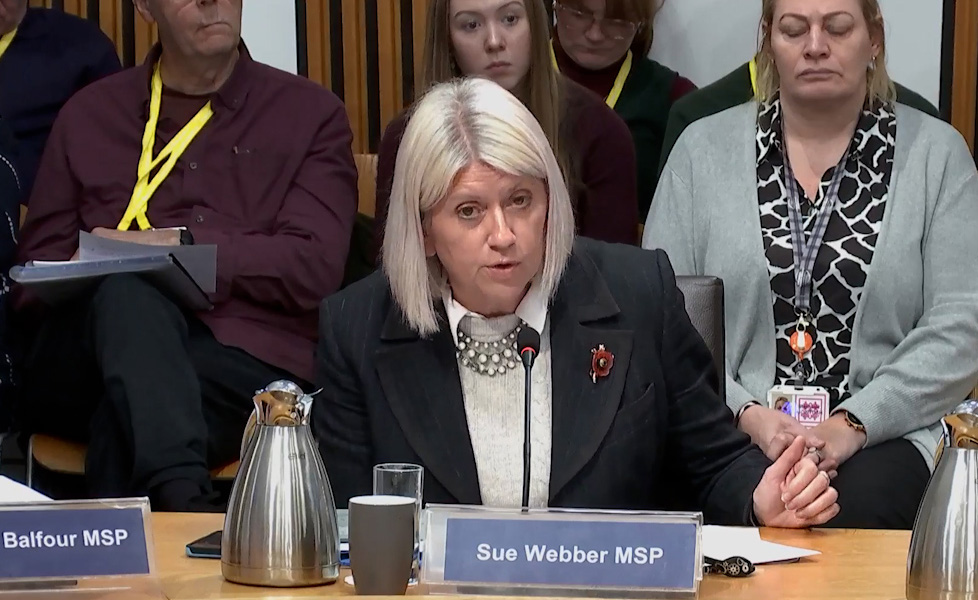
Scotland’s assisted suicide Bill is “spiraling out of control”, campaigners claim, after MSPs rejected key safeguards for young and vulnerable people and those living in poverty, during a Holyrood committee meeting.
A proposed amendment by MSP Claire Baker which sought to raise the minimum age for assisted suicide to 25, was rejected by the Health, Social Care and Sport Committee, which is examining the Assisted Dying for Terminally Ill Adults (Scotland) Bill.
Her amendment would have aligned the Bill with guidance from the Scottish Sentencing Council, supported by the Scottish Government, which recognises that the brain is not fully mature until around 25 years of age.
Dr Gordon Macdonald, CEO of Care Not Killing, which opposes the Bill said:
“Because the amendment was rejected, Scotland could now face the absurd position where someone under 25 may receive a lighter criminal sentence because their brain is considered immature yet still be eligible to seek assistance to end their life, an irreversible decision.”
Safeguards for disabled people proposed by MSP Pam Duncan-Glancy were also rejected.
Her proposal would have required medical professionals providing assisted suicide to undergo training covering:
- Palliative care and alternative care options
- Independent living principles under the UN Convention on the Rights of Persons with Disabilities
- Awareness of coercion, pressure or undue influence
- Equality and non-discrimination principles
The rejection of this amendment means there is no layer of protection for disabled people and those who may feel they are a burden, according to CNK.
Death requests driven by poverty or poor housing
The Committee rejected an amendment to ensure death requests are not driven by poverty or poor housing and a call for minimum training standards was also dismissed.
An amendment lodged by Jackie Baillie MSP, would have ensured that medical professionals involved in assisted suicide had specific training and qualifications, particularly when assessing:
- People under the age of 25
- Those with fluctuating or unpredictable illnesses
That amendment was rejected, as was Pam Duncan-Glancy’s (225) related proposal on mandatory training.
Conscientious Objection Undermined
However, the Committee accepted a proposal by Bill sponsor Liam McArthur MSP, which requires any medical professional who opposes assisted suicide to refer a patient to another doctor willing to participate.
Dr Macdonald said:
“While this amendment was presented as a compromise to protect professional conscience, in practice it forces doctors, pharmacists, and administrators who are morally opposed to assisted suicide to initiate the process. This does not constitute true conscientious objection and removes meaningful freedom of conscience for those working in the healthcare system.”
He said the amendment also means that those involved in an assisted death, but not the doctor, for example a nurse, pharmacist or administrator, would be required to take part and not be able to conscientiously object to being involved in an assisted suicide. It will drive many professionals into early retirement and exacerbate the workforce pressures already being experienced in the NHS leading to longer waiting times for specialist treatments, GP appointments and palliative care.
Threat to Hospices
Stuart McMillan MSP warned that hospices refusing to participate in assisted suicide could have their public funding withdrawn, a concern echoed by Jeremy Balfour MSP, who cited international examples of this.
However, Bill sponsor Liam McArthur said he was not inclined to support institutional objection, arguing it would “undermine choice”.
If passed, this could force hospices to close or have to abandon their ethical principles or risk losing funding, CNK claimed.
What happens when it’s not Peaceful, Painless or Quick?
Sue Webber MSP later raised concerns that assisted suicide drugs are not always painless, with international evidence showing cases of vomiting, choking, fluid in the lungs, and failed deaths.
When challenged by pro-assisted suicide MSP Emma Harper, who claimed there was “no evidence” of such side-effects, Brian Whittle MSP reminded the committee that such evidence had been presented at Stage 1 hearings.
Sue Webber concluded: “Even when we’re legislating for death, Parliament still bears responsibility for life.”
Turning despair into eligibility and pressure into permission.
Concerned CNK CEO Macdonald, said “essential and sensible” proposals were being rejected during the committee process and added:
“This Bill is spiraling out of control. Every protection that MSPs were promised at Stage 1 has been stripped away: disability safeguards, minimum training standards, proper conscientious objection and checks on whether someone is choosing death because of poverty or poor housing.
“Many MSPs supported the Bill in principle on the condition that robust safeguards would follow. Those safeguards have not materialised. What remains is a Bill that risks turning despair into eligibility and pressure into permission. We’re told this is about choice, but it is no choice at all when people feel they have no alternative.
“MSPs who backed the Bill with reservations now have a duty to act on those doubts. Don’t risk it.
“Even measures to protect hospices from being defunded have been rejected by Liam McArthur. Hospices may be forced to close or have no protection against being defunded by health boards, if they are unwilling to assist their patients to die by suicide.
“Moreover, the drugs being used in assisted suicides have been shown to result in complications leading to painful and distressing deaths by pulmonary oedema which is effectively drowning in one’s own bodily fluids.”