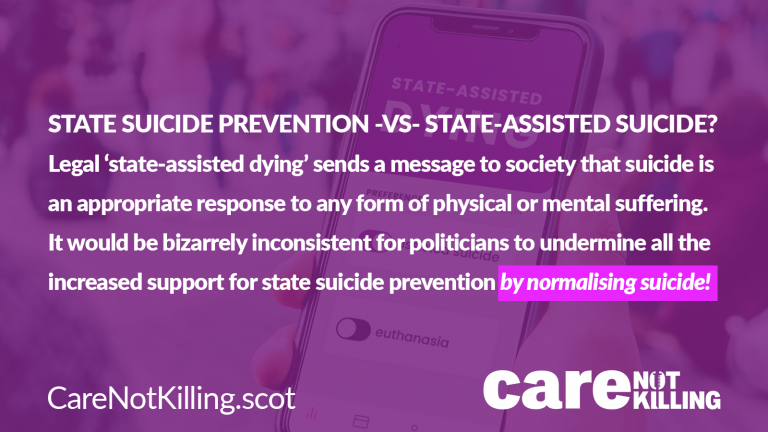
State Suicide Prevention -vs- State-Assisted Suicide
It is encouraging to see many Scottish politicians across all parties understand the need for, and commit to, improving our suicide prevention strategies and services. It is therefore extremely important that politicians consider the impact that legalising ‘state-assisted dying’ will have on wider society. How will they quantify what the impacts on suicide rates in Scotland might be if assisted suicide should become regarded by wider society as an acceptable solution?
One of the arguments that is being put forward at Westminster at present is that introducing assisted suicide or euthanasia will reduce suicides amongst those who are terminally ill. But evidence from some other countries shows the suicide rate amongst the general population has increased. In the Netherlands, suicides increased by 40% (2007 – 2016). The suicide rate in Oregon increased by 35% (2001 – 2018). In fact, the 2019 Oregon suicide rate was 35% higher than US national average.
Politicians must be very careful that they do not normalise suicide by changing the law on assisted suicide and sending out a message to wider society that suicide is an appropriate response to any form of physical or mental suffering. It is bizarrely inconsistent, on the one hand, to increase support and spending on suicide prevention strategies and, at the same time, on the other hand to undermine all that good work by introducing a mindset into the public domain that an appropriate response for those who are suffering is to end their lives.
What is the way forward for the future? It is to invest more in palliative care. We need to improve how we care for people, not kill them. Please support the proper funding of palliative care and oppose ‘state-assisted dying’ (assisted suicide and euthanasia).